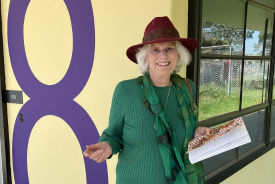
Her home, warm and wooden with a Japanese-style
garden, overlooks the cliff-lined ocean of Cardiff-by-the-Sea. This area is still
relatively untouched by Californias development craze, though the hum of I-5 traffic
hovers faintly in the distance. When asked how the chaos of living in Southern California
affects her work and life, Rosemary KimBal answers, "I avoid it." With a smile,
she adds, "Ive done a very good job of choosing exactly where I want to
be."
Though Rosemary KimBal majored in
art at the University of California, Santa Barbara, her true artistic career did not begin
until age thirty-five when she first visited the Tassajara Zen Center in Northern
California. "I knew from the first lesson (in calligraphy) I had found it,
that place of personal tranquillity."
That "it" is something
which is traditionally considered inexpressible, even by mystics of all religions. Until
her visit to the Tassajara Zen Center, KimBal led a completely different lifestyle, one
that would be undetectable in her present one. She refers to that period of her life spent
as President of an advertising agency and as a real estate agent, as "prior
lifetimes." A trickle of laughter comes as she says, " I feel like I have all
new cells."
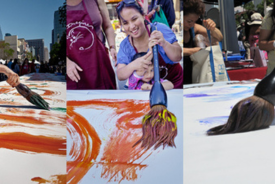
Zen not only involves painting, it
connotes a lifestyle. One of KimBals joys is to teach the art in a
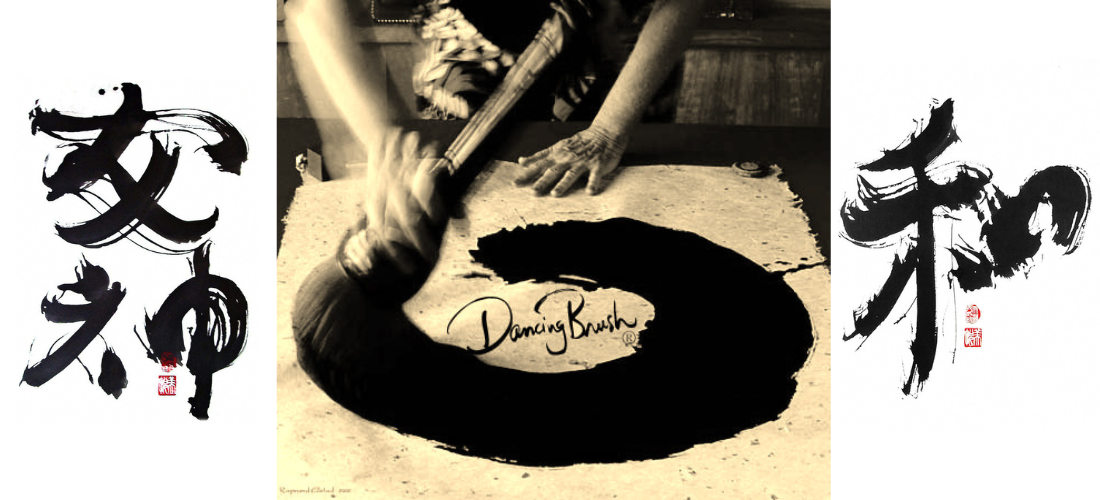
manner involving the totality of Zen. Classes at her Dancing Brush®
Studio begin with learning the art of traditional Japanese calligraphy to
train the hand. The calligraphy stroke is a different movement from the
drawing stroke in that it involves the whole arm, not just the fingers and
wrist. Next is a session in Tai Chi to clear the students’ minds. One of the
most important elements of Zen is to listen to your body. "All the answers
are in ourselves. The trick is to become quiet enough to hear them," she
says.
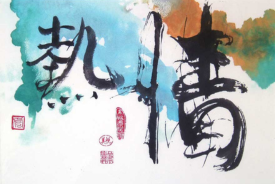
KimBal paints everything from
landscapes to figures to animals. Each of her paintings elicits a calming energy.
Sometimes a painting is done with a single brush stroke. This does not imply carelessness,
it can take many days and many attempts to achieve the perfection in the simplicity of a
single stroke.
"The kind of painting I do has
to be done all at once. You have to be at the stage where you are emotionally ready to do
it." She later adds, "Ive cried the whole way through some of my
paintings."
Its a feeling of relief to
find that space of emptiness where true art is created. "You cant try for it,
it just happens," KimBal says.
She does practice the traditional
style of Zen art and calligraphy, but specializes in a more contemporary and liberated
style. Her traditional style follows the ancient Zen brush painting called Sumi-e but
her contemporary style is abstract. The Zen artist, as the Zen practitioner, faces the
problem of how to express this thing called "Zen" without limiting it by words
and complexity. "The idea (of Zen art)," she says, "is to convey the
essence of the image in as few strokes as possible." Simplicity is essential.
The four tools used in Zen art -
the ink stone, ink stick, rice paper and bamboo brushes - are known as the four treasures.
Each brush is made of a different kind of hair, including horse, goat and sheep. As in
other types of painting, the kind of brush you use depends on the feeling you want to
convey. Horse hair is best for lines, sheep hair for softness. KimBal explains that the
process of grinding the ink before the actual act of painting is akin to meditation or to
"boring the left side of your brain." She relates that students are most
successful when they come with "a beginners mind" - meaning, to let go of
all preconceived ideas and expectations.
In the Wood River Valley
KimBals art is represented by Bellissimo. Terry Murphy, the proprietor, was
instantly drawn to the serenity and the simplicity of her work. Murphy explains, "
the store revolves around what is going to make people comfortable. Walking into the store
is like walking into a treasure chest." The hallmark of Bellissimo is its
cross-cultural eclecticism. "I am all about the Marco Polo mix," she says.
KimBals work has been
exhibited in Taipei, Taiwan, Canada and New York. This past year she was chosen to
represent the voice of Zen Art in America in an exhibition at New Yorks Ronin
Gallery. This exhibit named The Spirit of the Brush also featured Toko Shinoda, the
much-admired and treasured Japanese artist, as well as the 19-century artist, Kawabato
Gyokusho. Within the artistic community, Rosemary is known as Mei Yue`, meaning Beautiful
Joy, and this seal is affixed to each of her paintings.